- Best for
- anchoring a rental living room with a few styling touches
- Cost
- around $395 all in
- Difficulty
- easy—mostly textiles and arranging
- Time
- a 2–3 hour weekend job
What makes a warm japandi living room work in 2026
The cream-and-sage combination reads calm, but the calm comes from a few plain materials pulling more than their weight. The jute-look rug warms up a hard wood floor; the sheers soften daylight so the windows feel open rather than covered. The green throw and the pillow stack supply the slightly rumpled, lived-in texture, and none of it asks you to buy a new sofa. You can trace the look to two places at once—Scandinavian rooms and Japanese interiors—both of which start neutral and add color in small doses. The renter payoff: every piece rolls up, folds down, or boxes up when the lease ends.
My first attempt at japandi went too far the other direction—everything matched so tightly the room felt like a showroom nobody lived in. I genuinely stood at my own coffee table wondering where the warmth had gone. What fixed it was letting in one slightly off element at a time: a throw that wasn’t folded just so, a candle I could actually smell from the sofa, and a plant that looked like it wanted to be there. This room hits that middle ground for me—tidy lines, but nothing that feels like a hospital waiting area.
Layer 1 — jute-look area rug 5×7 ($180) woven surface that masks everyday footprints
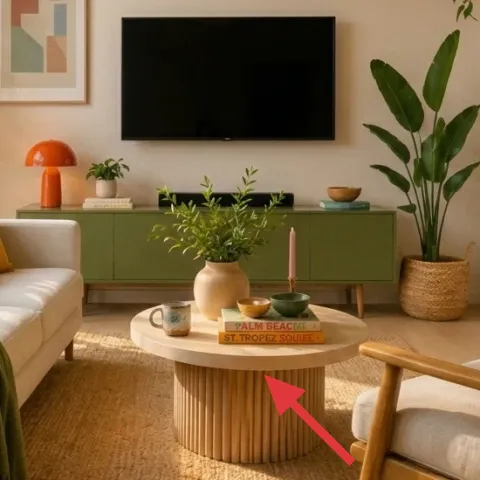
If your wood floors feel hard underfoot, a jute-look rug is the quickest fix, and a living room takes the brunt of daily life—foot traffic, dropped mail, and afternoons sprawled on the sofa. Look at the photo: the rug’s warm neutral tone separates the cream furniture from the walls instead of letting them blur together, and that woven surface is what gives the floor something to touch. A 5×7 footprint is big enough to gather the coffee table and both seats under one shape without making the room feel walled in. The catch is upkeep—a rug this natural-looking will want occasional spot cleaning, so favor a low-shed weave you can wipe down easily.
Choose the floor color first
Settle on the rug’s tone before you touch the pillows. A jute-toned neutral is the base that lets you add color confidently afterward.
Layer 2 — green throw blanket on sofa ($25) a muted accent you can swap by season
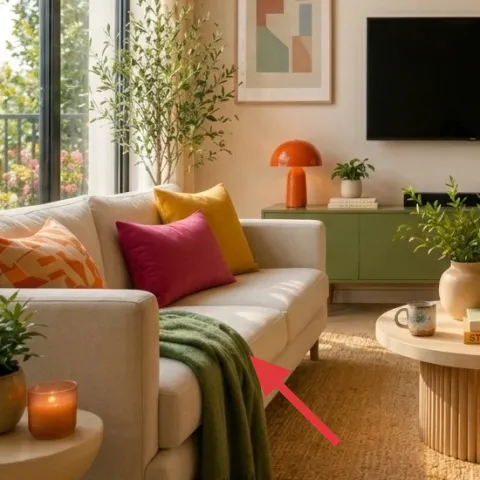
The throw takes up almost no visual room, yet it earns its $25: it interrupts the unbroken cream of the sofa and picks up the green of the plants across the space. I draped it instead of folding it into a crisp rectangle, which stops the couch from looking staged. You get the casual, someone-lives-here feeling without buying a single new piece of furniture. People often reach for more pillows instead, but a throw plus a couple of pillows looks warmer at first glance and gives your eye a few textures to travel across. The downside is practical—loose fabric snags on zippers and claws, so tuck it back into place on your way out the door.
Chase the undertone, not the exact shade
The green in this room sits on the dusty side, so reach for sage or olive instead of anything bright or blue-leaning.
Layer 3 — sheer curtain panels pair ($80) filtered daylight on removable hardware
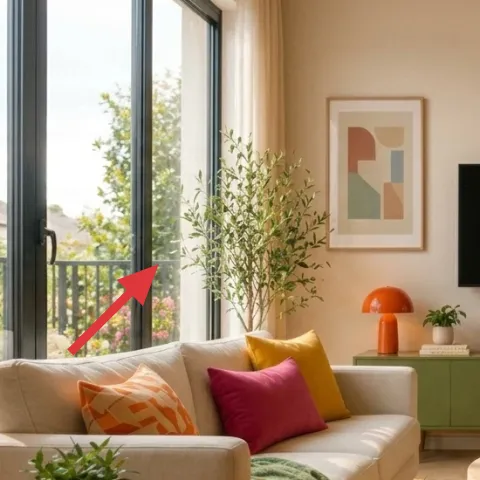
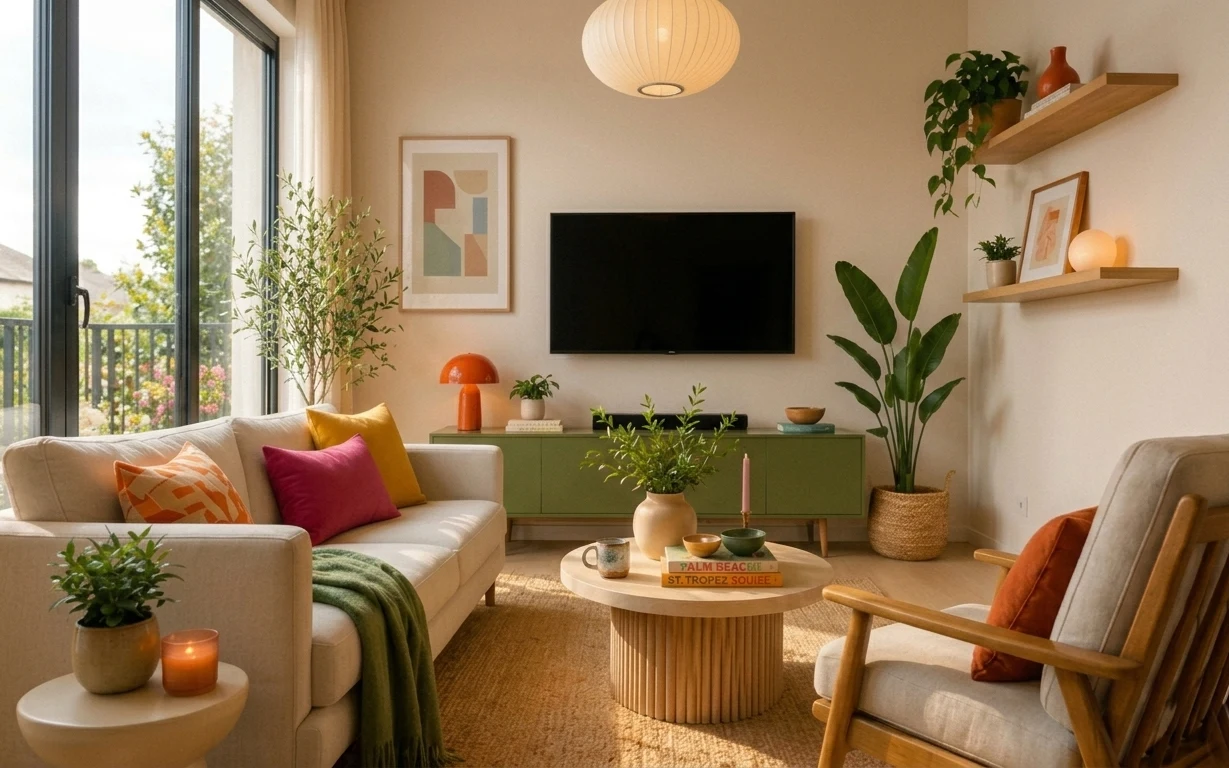
Sheers are what keep a room reading calm even when the furniture leans loud. In the hero shot, the panels strain the window light so the room stays bright without the harsh glare, and their long vertical lines draw the eye upward so the ceiling feels higher. Because they’re just hanging cloth, a renter can switch them out in minutes and never touch the landlord’s rod or brackets. Privacy is the trade-off—on their own, sheers stay see-through, so plan on the shades already at the window for nighttime, or a second layer if your lease lets you add one. Even so, the open, japandi-leaning light is worth the compromise.
Keep the hem off the floor
Sheers that puddle at the floor make the room read shorter, not taller. Aim for a clean drop that just brushes the sill or stops a touch below it.
Layer 4 — framed wall art print above TV ($25) echoes the room’s warm shapes
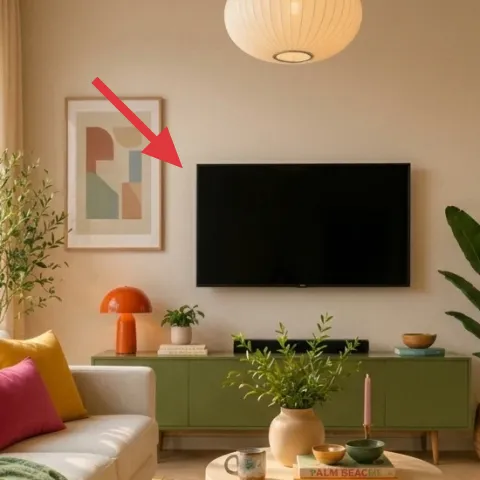
Hanging the print above the TV fills out a wall that would otherwise read blank and links the room’s colors back to one another. The piece in the photo uses soft blocks of warm color in a muted palette, which sits comfortably beside cream upholstery and sage-green extras. For renters, framed art is about as low-stakes as decor gets—picture-rail hooks if you’ve got a rail, Command Strips on painted walls otherwise. The one thing to watch is the frame: a flimsy one looks cheap from across the room, so spend a little on a heavier frame even when the print itself was inexpensive.
Add a plain mat
A single clean mat around an abstract print looks more considered than cramming the wall with a busy gallery arrangement.
Layer 5 — ribbed coffee table tray ($20) corrals small objects into one boundary
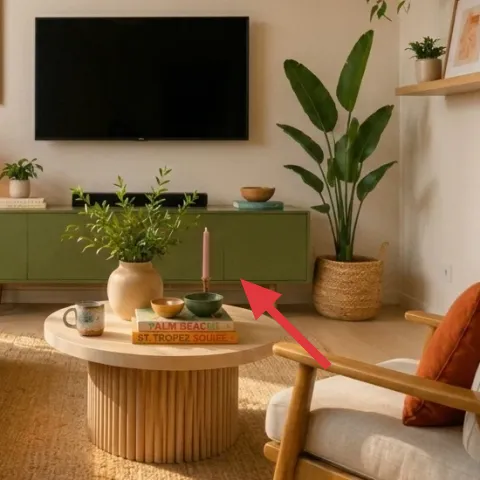
Drop a tray on the coffee table and a scattered handful of objects becomes one tidy arrangement. Here the tray’s warm, ribbed texture rhymes with the mid-century table and gives the candle and the other small pieces a clear place to sit. Skip it and even attractive things start to look like clutter spread across the surface. It also tames the daily mess—remotes, stray coasters, and a little planter all feel deliberate once they share a single edge. The thing to mind is height: pick a tray low enough that nothing on it blocks your view of the TV.
Repeat one texture, not five
The tray’s ribbing mirrors the table’s, which means everything else on top can stay smooth and matte.
Layer 6 — terracotta jar candle on tray ($35) evening light in an earthy clay tone
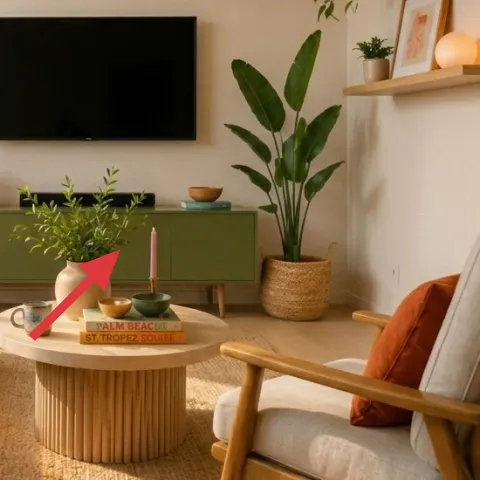
The terracotta jar candle gives the room a settled-in-for-the-evening warmth that no overhead bulb can copy. Placement does half the work—it sits on the coffee table beside the books and a small bowl, so it looks like part of the arrangement rather than something I grabbed on a whim. My recurring candle mistake is playing it too safe; a plain white jar always ends up looking like an afterthought. The clay color earns its spot because it picks up the room’s terracotta accents and the wood tones. The only thing to weigh is scent—choose one light enough that it doesn’t wrestle with the plants.
Pour your own instead of buying
Make a poured candle in a warm terracotta shade so it lines up with the coffee-table palette—no detour through the expensive candle aisle required.
Materials
- Soy wax flakes — about 1 lb — craft store — $12
- Wick + wick stickers — 1 set — craft store — $3
- Heat-safe glass jar — 1 medium jar — thrift or craft store — $6
- Candle dye (terracotta range) — 1 small bottle — craft store — $5
- Fragrance oil (warm, light) — 1 small bottle — craft store — $2
Steps
- Wash the jar and dry it completely, wiping the inside so the wax sets with a smooth top.
- Stick the wick tab to the center of the base, attach the wick, and trim it so it stays upright in the middle.
- Weigh out the wax flakes and tip them into a heat-safe pouring pot.
- Heat the wax slowly until it’s fully liquid, stirring gently so the texture stays even.
- Mix in the fragrance oil, then work the dye in bit by bit until you land on the right terracotta shade.
- Pour the wax into the jar and leave it undisturbed while it firms up.
- After the top has set, let it cure in a cool spot until the burn pool behaves predictably.
- Cut the wick down to roughly 1/4 inch before you set it on the tray.
Total DIY cost: $28 — saves about $7 over buying.
Layer 7 — potted floor plant in woven basket ($30) full-height greenery beside the shelves
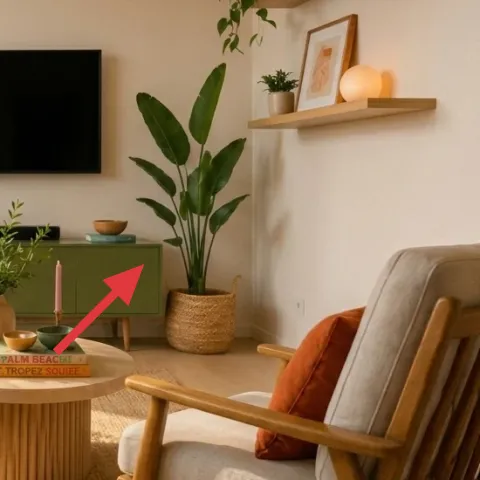
Set a floor plant in a woven basket and the room gains height, which makes the seating feel arranged on purpose and frames the shelves on the right. In the hero photo the leaves look full and a little glossy, so the plant feels alive without pulling attention away from the TV or the art. The basket is a practical choice as much as a pretty one—its weave matches the rug and the tray, which keeps the room feeling like one thought. Logistics are the trade-off: a big plant gets heavy, so for a renter it pays to keep the pot to a size you can lift and move on your own. Watering stays uncomplicated as long as a saucer sits underneath.
Give it a quarter turn
Spin the pot a quarter turn every couple of weeks so it grows evenly and keeps a balanced shape.
The cost, layer by layer
| Layer | Item | Cost |
|---|---|---|
| 1 | Jute-look area rug 5×7 | $180 |
| 2 | Green throw blanket | $25 |
| 3 | Sheer curtain panels pair | $80 |
| 4 | Framed wall art print 16×20 | $25 |
| 5 | Ribbed coffee table tray | $20 |
| 6 | Terracotta jar candle | $35 |
| 7 | Potted floor plant in woven basket | $30 |
| Total | $395 | |
Need to trim further? Drop to a tighter-weave 5×7 rug, commit to a single pillow color rather than a mix, and pour the candle into a thrifted jar—all while holding onto the same warm terracotta palette.
What worked, what didn't (across the whole room)
The thing that carries this room is the texture mix—a woven rug, filtered light through the sheers, and matte accessories together keep it from going flat. The plant pulls its weight too, contributing height and a little movement without a furniture purchase. Where it can fall apart is color: let the green or the terracotta tip too bright and the quiet japandi mood evaporates.
What worked
- The rug’s warm weave gathers the sofa and armchair so the seating reads as one grouping.
- The sheers diffuse the daylight, brightening the space without the harsh glare.
- The green throw supplies a muted contrast that agrees with the plant tones rather than clashing.
- The framed print over the TV gives the wall a focal point and holds the palette together.
- The tray gathers the small objects so the coffee table never looks haphazard.
- The terracotta candle brings evening warmth and repeats the room’s earthy colors.
What didn't
- Go too dark on the rug and the cream sofa starts to feel weighed down and less welcoming.
- Sheers hung too long puddle on the floor, making the room look shorter and a little unkempt.
- Pile on too many bright throw colors and the calm, pared-back baseline disappears.
- Leave out the tray and the stacked decor reads accidental instead of arranged.
- An overpowering candle scent ends up fighting the fresh, green feel of the plants.
What we'd skip if we did it again
Don’t buy a matched set for the coffee table. The arrangement works precisely because the candle, books, bowl, and plant look gathered over time, not bought together as a coordinated product line.
Pass on bright, high-saturation swaps. Holding the green to sage or olive and keeping the terracotta warm rather than neon is what keeps the room calm and true to japandi styling.
Avoid heavy, blackout-style treatments as a starting point. Even when you need privacy, hang the sheers first and add only the minimum extra layer—that way the light stays diffused and the room never feels closed off.
Frequently asked
Will this still work if my lease bans hooks and nails?
It will—almost everything you see here is either a textile or a tabletop piece that leaves no mark. The rug rolls up and comes with you, the sheers ride on removable hardware, and the tray and candle just go in a box. Wall art is the only exception: use whatever your unit already allows, whether that’s a picture rail you can hook onto or Command Strips on a painted wall where they’re permitted.
Roughly how much time should I set aside for the whole thing?
Plan on about 2 to 3 hours for the main work—laying the rug, hanging the sheers, and styling the sofa and coffee table. Mounting the framed print adds a little depending on how you attach it. The candle pour is the variable, since it needs time to cure, so I’d make it the day before or set up a pour-and-cure window and style the rest of the room around it.
My living room is smaller than this—does the plan still hold?
Yes, just shrink it without changing the logic. A 5×7 rug still gathers a compact seating zone, and you can cut visual weight by sticking to one throw color and fewer pillows. Keep the sheers—they’re what makes a small room feel taller. For the wall, hang a single framed print rather than a cluster so the space stays uncluttered.
What if my living room is large and feels bare?
Work with the proportions you’ve got. Step up to a larger rug if the floor allows it, and add a second plant grouping on a console or shelf. One small print can look lost on a big wall, so go up a size while keeping the same warm, abstract palette. The tray idea still applies—just build out the tabletop arrangement so it doesn’t read as too sparse.
Where should I shop for the pricier pieces?
For the jute-look rug and the sheers, big-box and home-goods stores tend to carry the renter-friendly sizes most reliably. For art, look for common print dimensions like 16×20 that drop into standard frames, then keep the frame finish warm—wood or a warm black. The candle and tray are easiest to source secondhand or at a decor shop where you can match the terracotta tones in person.
What’s the mistake people make most often with this style?
Reaching for colors that are both too saturated and too cool at the same time. Japandi looks best when the neutrals stay warm—cream, tan, honeyed wood—and the accents stay quiet, like sage green and warm terracotta instead of bright lime or fire-engine red. Get the palette right and the rest, from textures to plants to tray styling, falls into place far more easily.