- Best for
- A one-weekend patio update
- Cost
- $620 all in
- Time
- 4–6 hours, plus drying time
- Difficulty
- Comfortable beginner DIY
How an olive-and-warm-wood patio corner became my favorite seat in 2026
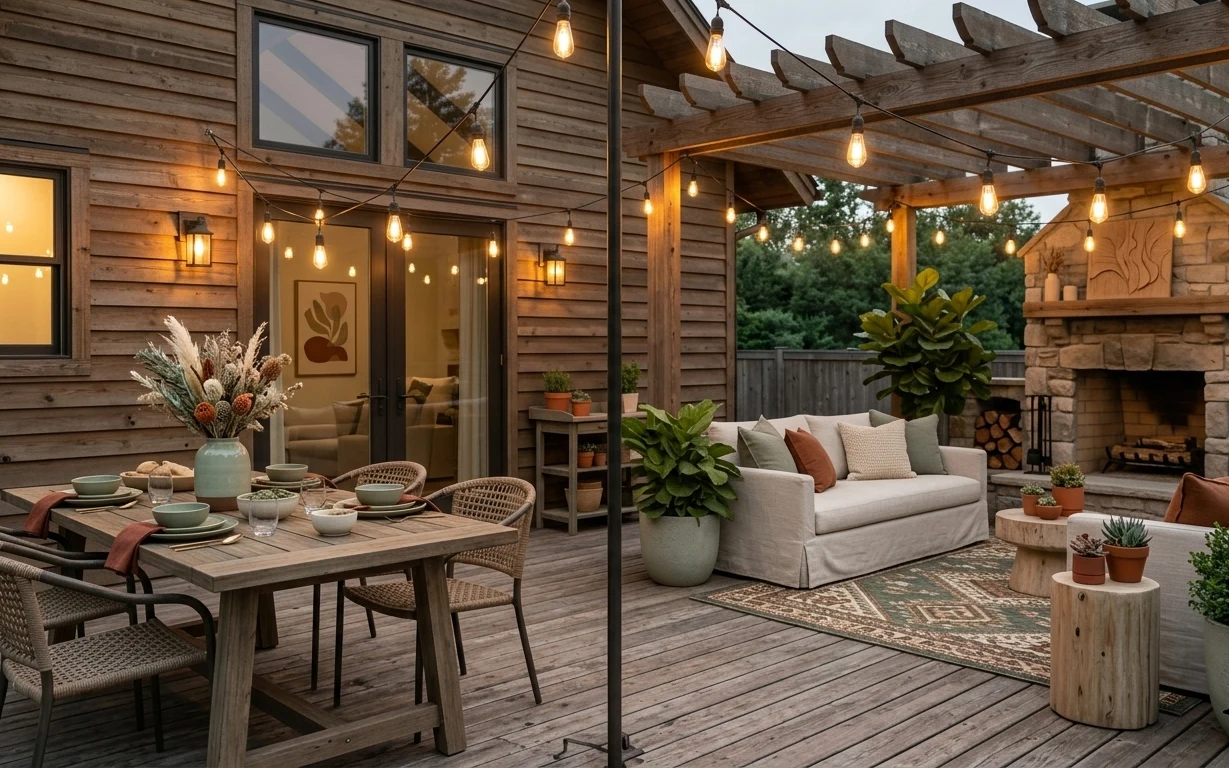
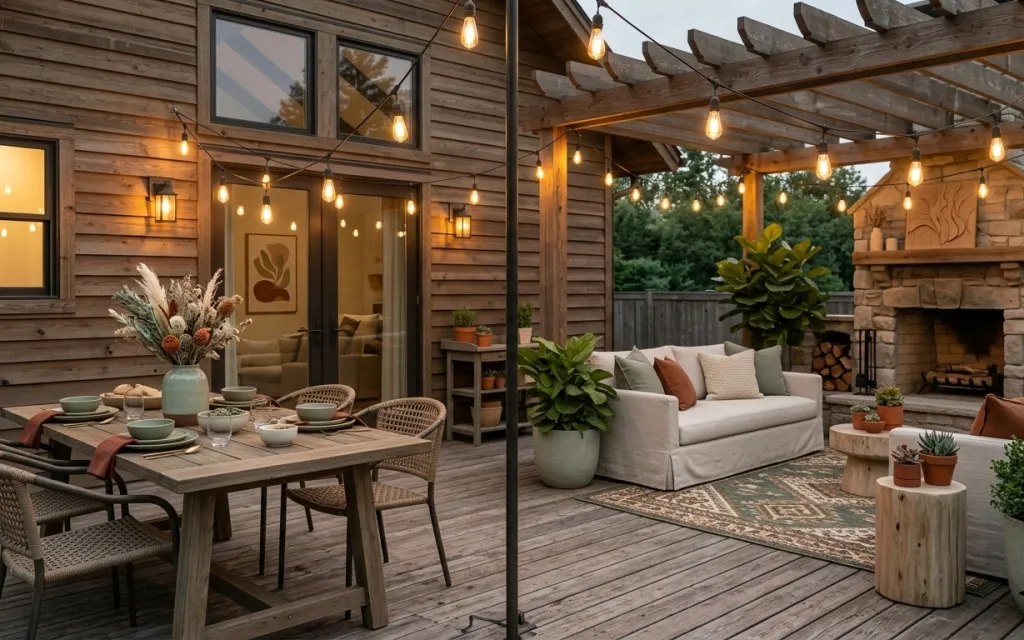
When the porch already has decent bones—a wood deck underfoot and shiplap-style walls—the quickest path to a finished feel is adding softness right where your eyes settle: a rug below the seating, pillows on the sofa, and a strand of light overhead. Look closely and the textures carry the room: the weave of the rug, the matte ceramic of the planters, and that warm glow bouncing off the wood. You can pull this off on a normal budget because you get to spend on the things that actually move the needle—the rug, the lighting—rather than fussing over tiny accents first.
For years I did this backward. I’d start with little extras—a fresh candle, one new pot, a sign I grabbed on impulse. Nothing looked bad, it just never looked settled. The shift came when I saw how fast a generous rug and some warm light make the rest of a space read as deliberate. Lay that foundation, and suddenly the plants and the art quit competing for your attention.
Layer 1 — area rug ($120) sets the floor for everything else
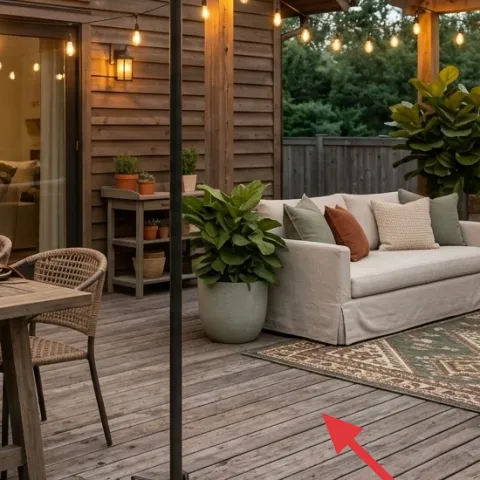
The outdoor rug tucks under the sofa and draws a clear line between the seating area and the rest of the deck. More than any single item, it’s what makes the corner read as planned rather than just filled with furniture—it widens the visual footprint under your feet and gathers the colors into one palette. There is a catch: a rug asks for a bit of upkeep. Shake off the leaves, rinse spills before they set in, and pick one you genuinely like looking at so you’re not itching to swap it in a season. Next to a pillow or planter change, the rug is the one move that actually reshapes the space.
Pull rug colors straight from the deck
Stick to tans, creams, and rusty reds that already live in the wood tones, and the rug reads as part of the room instead of a stray purchase.
Layer 2 — outdoor sofa ($250) draws the low, easy seating line
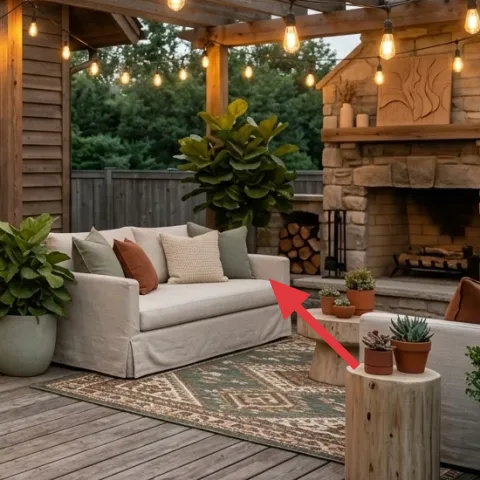
The sofa is the long, low piece on the right, and it stands out cleanly against the pale shiplap wall and the darker stone fireplace. Cushion choice carries more weight outdoors than people expect, because fabric texture is the first thing your eye clocks. Here the neutral covers step back and let the rug pattern and the terracotta do the talking. You could chase a bold “statement” cushion instead, but that tends to read as noisy once the rug already brings pattern. Holding the sofa and pillows in creams and greys leaves you room to shift the look later with plants, lantern light, and seasonal pillows.
Put the color in the pillows, not the couch
A neutral sofa lets you reset the palette anytime with a few throw pillows and a couple of pots, no big purchase required.
Layer 3 — string lights ($30) fill in the bare space overhead
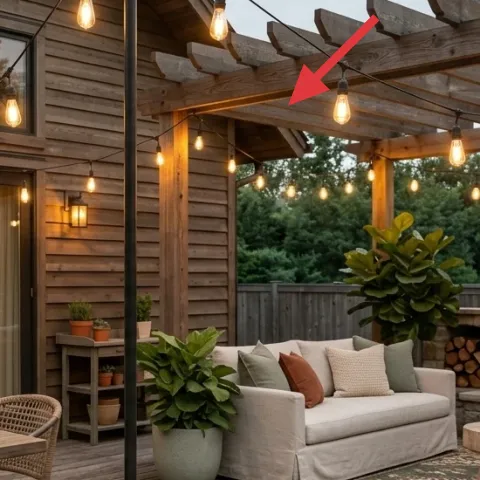
Run across the patio toward the ceiling beams, the string lights fill in the exact zone where most outdoor setups feel half-done. They earn their keep even in daylight, since the lines they trace overhead hint at slow evenings and mark a path through the seating. The work is in the planning: leave enough slack that the bulbs don’t dip onto people’s heads, and route the cord where nobody will snag it. Even so, one strand spread across the whole area beats a single spotlight, which only lights one corner and leaves the rest flat.
Pick a bulb tone that flatters the wood
Go for warm bulbs, around 2200–2700K, so the deck stays honey-toned instead of tipping orange-red.
Layer 4 — framed abstract artwork ($80) gives the stone wall a counterweight
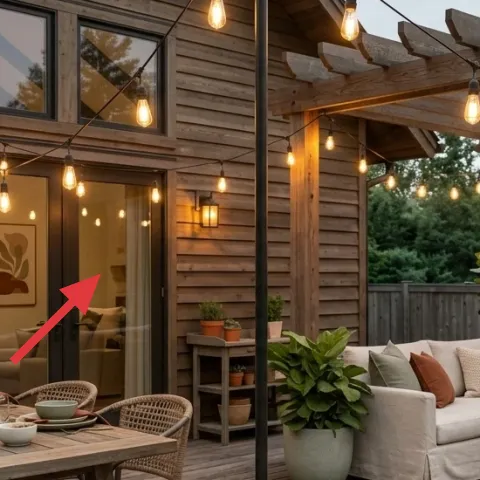
The framed prints on the shiplap give your eye a vertical place to rest, so it isn’t only sliding left to right across the sofa and rug. They also stitch the indoor-outdoor feeling together: the muted shapes pick up the patio’s earthy palette, so the art belongs rather than just hanging there. Skip it and lean on plants alone, and the wall loses that considered moment—which matters more when you’ve got something as bold as a stone fireplace nearby. The one call to get right is scale. Keep the frames medium so they hold their own against the texture of the wall.
Tiny frames lose the fight with texture
Set against shiplap and stone, small frames just vanish and leave the wall looking half-dressed.
Layer 5 — wall lantern light ($45) drops a second pool of warm light
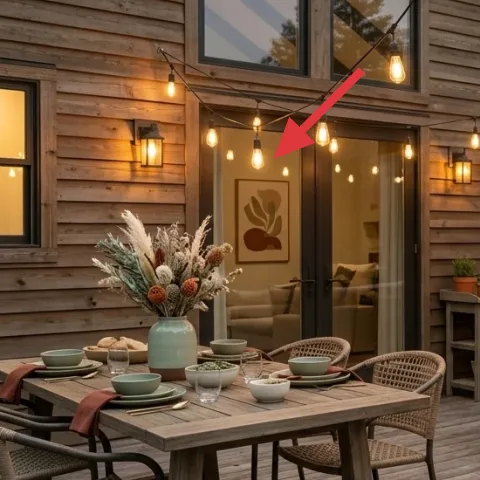
The lantern mounted on the exterior wall throws a tighter, warm glow that plays off the strand overhead. Stacking light at two levels is what keeps the patio feeling settled even in the wide shot, since the room isn’t leaning on a single brightness. The risk with wall fixtures is finish: the wrong metal can look out of place against your other hardware. Here the lantern’s tone sits comfortably with the warm wood. And unlike a single table lamp, a wall fixture brings height and direction, so the seating and the dining table catch light from more than one angle.
Where you mount it beats how bright it is
Set the fixture up high and the light falls softer across the cushions and the pots below.
Layer 6 — large ceramic plant pot ($25) brings one clean sculptural shape
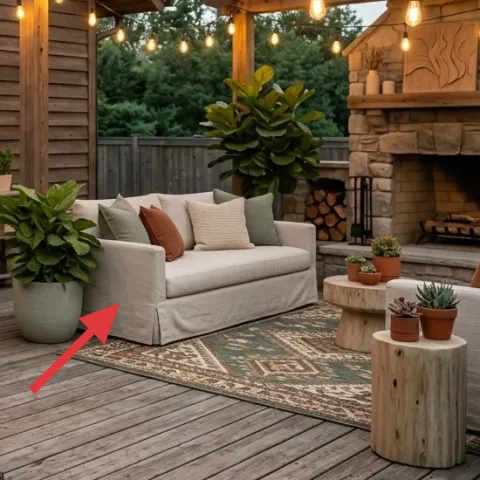
The big ceramic pot holds a leafy plant and stands like a column between the sofa and the rug. Ceramic looks cleaner and a notch more grown-up than plastic, and the matte glaze keeps the palette from going shiny or plasticky. The other route is crowding that corner with a bunch of small pots, but a pile of containers quickly makes the seating feel cluttered. One larger pot leaves space to breathe while still bringing in green. It also gives the rug pattern more purpose, because the plant’s silhouette adds one more layer of texture beside it.
Let one large pot do the heavy lifting
Scatter a few small pots elsewhere if you like, but lean on a single tall container for the vertical height.
Layer 7 — terracotta plant pots ($70) repeat a warm, earthy beat
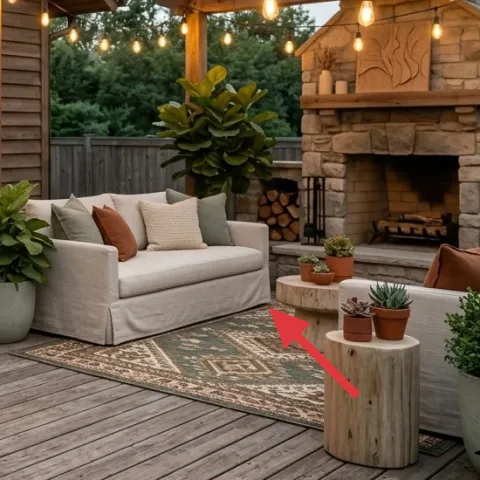
A handful of terracotta pots placed around the patio—beside the sofa, along the edge—drop little hits of warmth that answer the wood deck and the glow from the lights. What makes it land is repetition: seeing the same clay tone in more than one spot reads as a choice, not a pile of mismatched thrift finds. The downside is weather. Terracotta fades over the seasons, and paint chips if you don’t seal it well. That’s exactly why a paint refresh is such a satisfying weekend task here—you reset the color and the whole outdoor palette looks freshly handled again.
Refresh them yourself instead of buying new
Paint and seal the terracotta pots so their color falls in line with the patio palette and they look freshly done—no need to replace a single container.
Materials
- Outdoor primer (spray) — 1 can — Home improvement store — $18
- Exterior matte paint — 1 can — Home improvement store — $12
- Painter’s tape + drop cloth — assorted — Home improvement store — $10
- Small sanding block (fine grit) — 1 — hardware store — $8
- Outdoor sealant (matte) — 1 can — hardware store — $9
Steps
- Clean the pots thoroughly and let them dry completely.
- Lightly scuff-sand the surface so primer grips.
- Mask drainage holes and any label areas with painter’s tape.
- Apply a thin, even coat of outdoor primer; avoid heavy runs.
- Let primer dry fully, then sand any roughness lightly.
- Spray 2 light coats of exterior matte paint, letting each flash-dry.
- Wait for paint to cure before handling.
- Apply 1–2 light coats of exterior sealant; keep coats thin.
- Let the sealant cure fully outdoors before returning pots to the patio.
Total DIY cost: $57 — saves about $13 over buying.
The cost, layer by layer
| Layer | Item | Cost |
|---|---|---|
| 1 | Outdoor area rug (5×7) | $120 |
| 2 | Outdoor sofa with neutral cushions | $250 |
| 3 | String lights set | $30 |
| 4 | Framed abstract artwork (16×20) | $80 |
| 5 | Wall lantern light | $45 |
| 6 | Large ceramic plant pot | $25 |
| 7 | Terracotta plant pots (DIY refresh) | $70 |
| Total | $620 | |
If money runs short on the sofa, keep what you have and put the budget into the rug and string lights first. On a lot of patios those two changes deliver the “done” look faster than new furniture does, and they make the plants and art read as more deliberate in the bargain.
What worked, what didn't (across the whole room)
The clearest win is the layering of light and texture: rug down low, string lights up top, and a lantern pooling in between. The next is keeping the palette in check—the neutral seating and art let the wood deck, the stone fireplace, and the terracotta pots come together as one story instead of four.
What worked
- The rug draws a clear boundary around the seating zone on the bare deck.
- String lights add a second layer up high, so the patio stays inviting after dark.
- Neutral cushions stop the pattern from getting noisy where the sofa meets the rug.
- The framed prints keep the shiplap from looking bare next to the stone fireplace.
- The single tall ceramic pot adds height without crowding the corner.
- Repeating the terracotta color links the pots to the warm wood and lantern light.
What didn't
- Sticking to only small pots would have left the patio feeling busy rather than planned.
- Dropping the wall light would leave a hard gap between the strand above and the deck below.
- Going too bold with the pot paint would set the terracotta at odds with the rug pattern.
- A rug full of stray cool tones would have clashed with the warm wood deck.
What we'd skip if we did it again
Don’t lead with a new sofa. Even a solid outdoor couch falls flat when the rug and lighting aren’t in yet, so that first chunk of money rarely shows up in the look.
Don’t reach for three pot colors at once. The repeating terracotta is carrying the planters; toss in too many tones and the plants start reading as separate buys instead of one palette.
Don’t hang art that’s undersized for a textured wall. With shiplap and stone in play, medium frames are what stop the wall from looking like empty filler between the bigger features.
Frequently asked
How much time should I set aside for a patio refresh like this?
Most of it—shopping, then laying the rug, hanging the lights, propping the frames, and arranging the pots—fits into one afternoon. The only slow part is the DIY pot painting, since the primer, paint, and sealant each need time to dry and cure; pencil in an extra day for that. String lights are easy to fine-tune after dinner once everything else is in place and you can judge the spacing in low light.
I rent and can’t mount anything on the wall—can I still do this?
Start with the rug, the sofa cushions, and the string lights, since none of those touch the wall. Swap the wall lantern for a plug-in version, or drop it entirely and add a bit more coverage with the string lights instead. A grounding rug plus a warm strand overhead still gets you a finished-looking patio with nothing screwed into the siding.
My patio is on the small side—do I need the same size rug?
Go a size down if you need to, but hold onto the coverage rule: the rug should reach under the front legs of your seating so the whole arrangement reads as one zone. If a full set won’t fit, pull back on how much dining area sits on the rug rather than shrinking it so much that it ends up floating under just the coffee table.
What’s the most common slip-up with outdoor planters?
Buying a bunch of different pot colors and then trying to patch it together with random extras. Settle on one repeating color—terracotta works—and one bigger anchor pot for height. Add only a small pot or two beyond that, so the plant shapes back up the rug and sofa rather than fighting them for attention.
Where can I buy these pieces without blowing the budget?
For rugs, hunt down outdoor-rated options at home stores and online marketplaces, but weigh the pile and the UV-fade rating before the price. For art, look for print sets in a similar size and keep the frames plain. String lights tend to drop during seasonal sales—grab a set that clearly lists weather resistance.
Is repainting terracotta actually worth it versus buying new pots?
It’s worth it when the pot shapes already suit you and you just want the color to match your palette. Painting beats replacing everything on both speed and cost, and it lets you rescue pots that have faded. Just lean on a proper primer and an exterior sealant so the finish stands up to sun and rain.